← Selected work · 05 — E-commerce · Shopify · Japan to Nigeria
J2U: one all-in price for authentic Japanese products in Nigeria
J2U brings hand-picked Japanese beauty, snacks and merch to customers in Nigeria. I ran discovery, designed the store with the founder and directed the Shopify build, around one idea: show the real price and the real wait before anyone pays.
- Role
- Designer and builder
- For
- The founder of J2U (Japan To You)
- Platform
- Shopify, paid Sleek theme
- Status
- Opening 31 October 2026
The problem
Buying Japanese products from Nigeria usually means unclear total costs, long and untracked delivery, and nobody local to ask.
My role
Ran discovery and a competitor audit, wrote the build spec, designed 27 page boards and a brand system for the founder’s approval, and directed an AI-assisted Shopify build.
The result
27 approved page designs and a store built to open on 31 October 2026. There are no sales or traffic results yet, so none are claimed.
01 — The problem
Importing from Japan is a guess until the parcel arrives.
J2U is modelled on Japan Haul, the best-known haul store. I walked japanhaul.com on desktop and phone on 14 October 2026 and read its public product feed of 1,103 products. The shopping is energetic, but the promise is weak: processing takes 3 to 5 business days, the cheapest shipping option takes 4 to 12 weeks and is not trackable, and the free-shipping rules carry a long list of exclusions.Public
Ingredients are only in Japanese with no translation, there is no local stock or support, and the cart is the weakest page: no progress bar, no upsell, and a minimum-order message that is not explained. Skincare, the category J2U wants to own, is thin.Public
That left a clear gap for a store that is honest about cost and time and has people in the country. The founder also plans to open beyond Nigeria within a year, so the design could not be Nigeria-only.Judgement
02 — My role and how we worked
One spec, one approval path.
I was designer and builder; the founder owned the business decisions. Before any build started, the founder approved three things: the discovery and strategy document, the brand style guide, and the 27 page boards. The build was approved on 13 October 2026, and the store targets 31 October.
I wrote a single build document that every working session started from: the approved sources, standing rules, the brand tokens, the build phases, the acceptance criteria and a decision log. Open items stayed in square brackets, for example delivery rates and dates, and were filled only from the founder’s confirmed answers, never guessed.
The build ran through an AI assistant connected to Shopify, working on an unpublished copy of the theme. It could not publish the theme, refund, move money or manage staff. I reviewed every change in preview and published it myself. The design decisions, the approvals and the standing rules were mine and the founder’s.
03 — Design decisions
Four design calls.
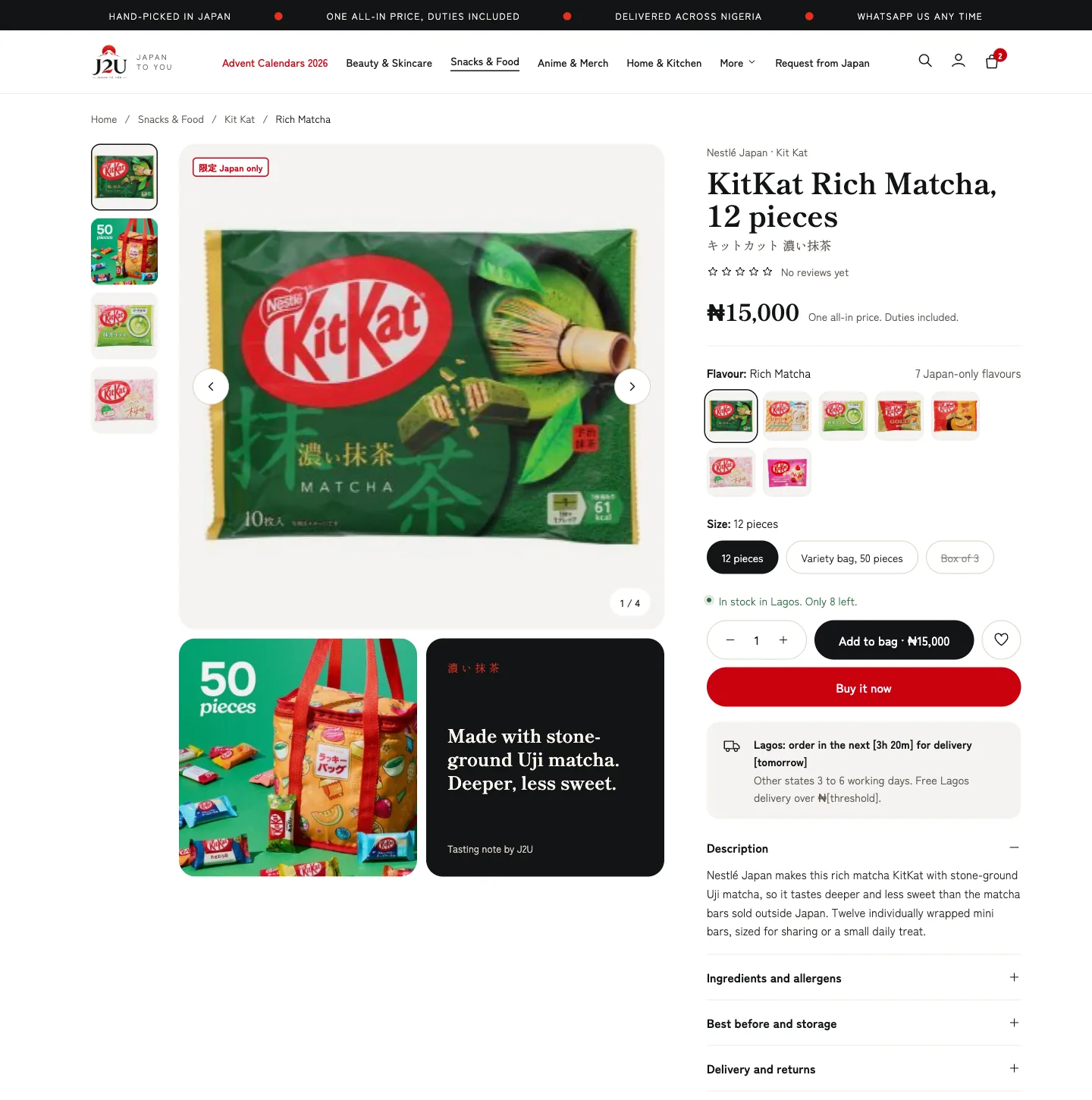
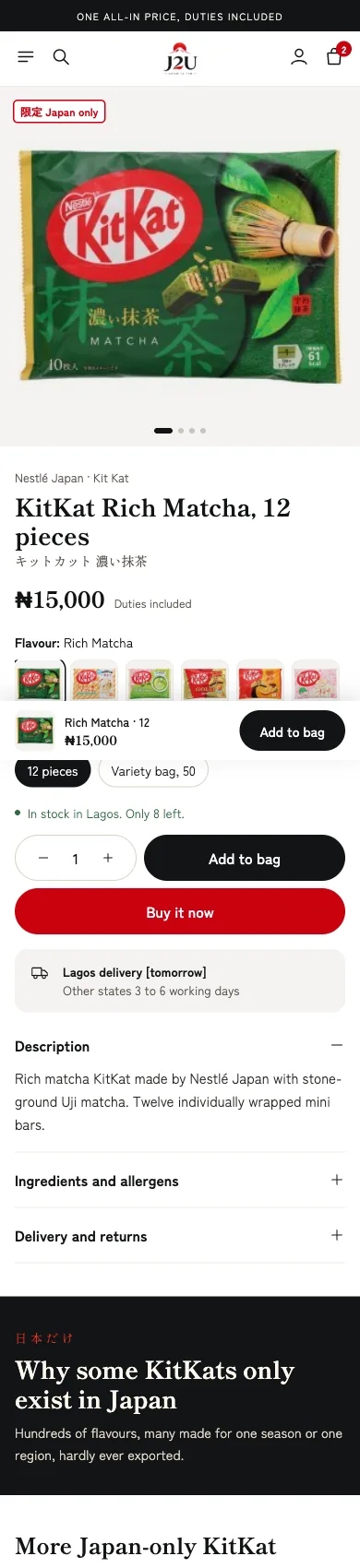
One all-in price, on every product
Every price reads “One all-in price. Duties included.” under the number. The announcement bar says it too, and the cart and checkout show “Duties and import: Included” as a line. A shopper never meets a cost at the door that was not in the total.Design-level
Two stock states, shown before adding to the bag
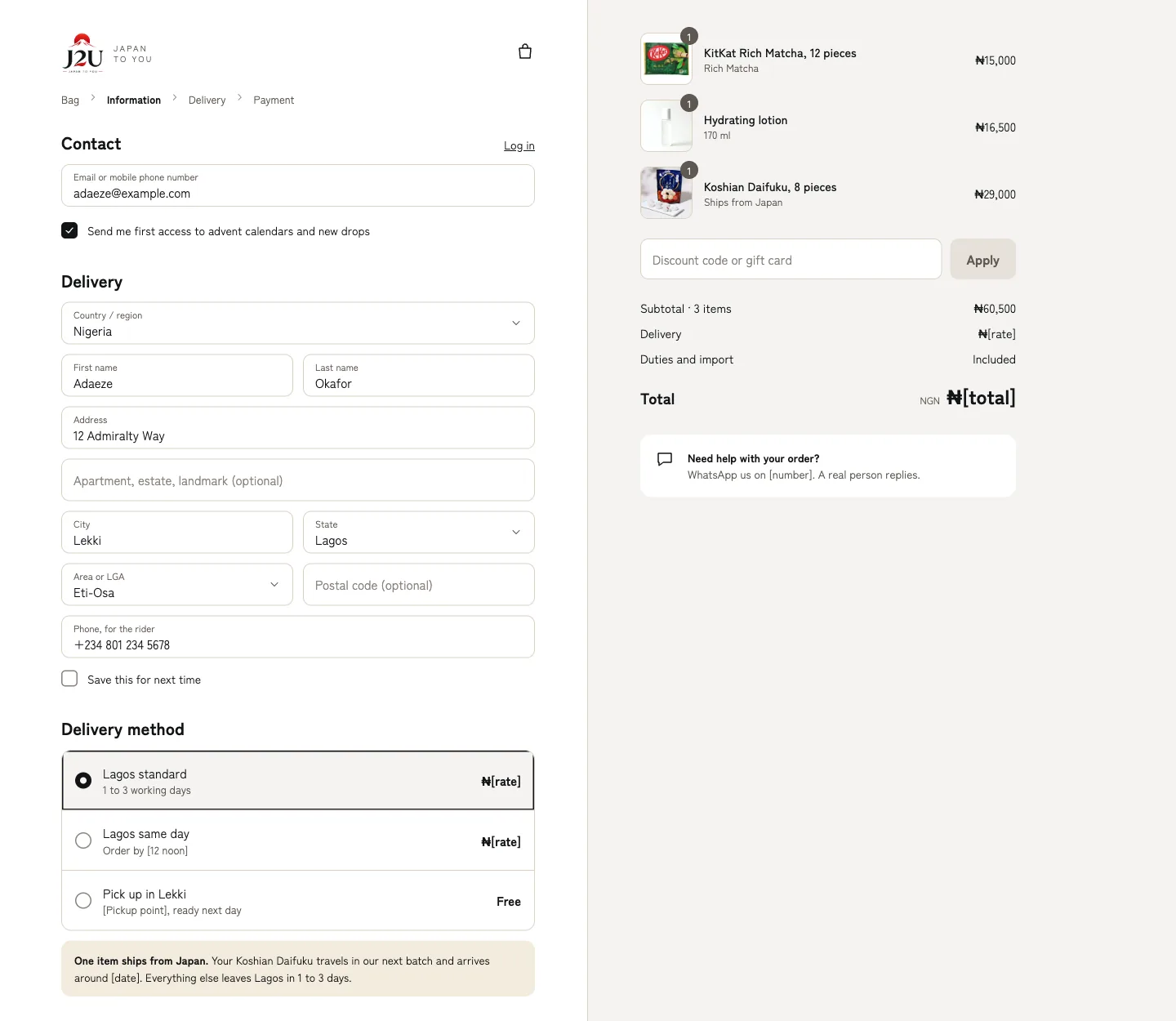
Each product carries a coloured stock line. “In Lagos” means it is in stock and ships in 1 to 3 working days in Lagos and 3 to 6 days elsewhere. “Ships from Japan” means it is bought after the order and arrives in the next air batch. An order that mixes both arrives in two parts, and the customer never pays delivery twice for one order. The two states use two colours and two words, never colour alone.Design-level
Request from Japan as a core service
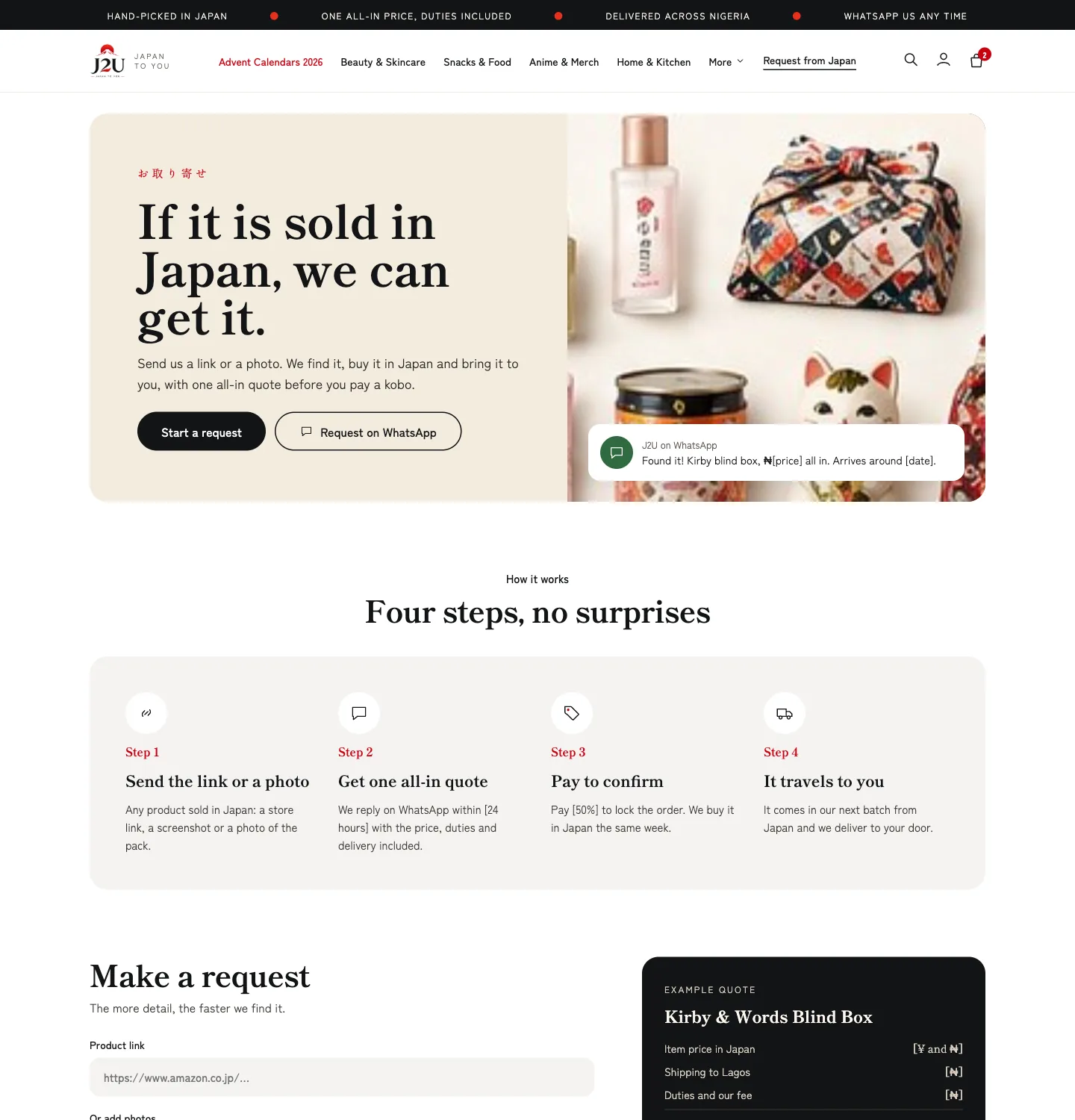
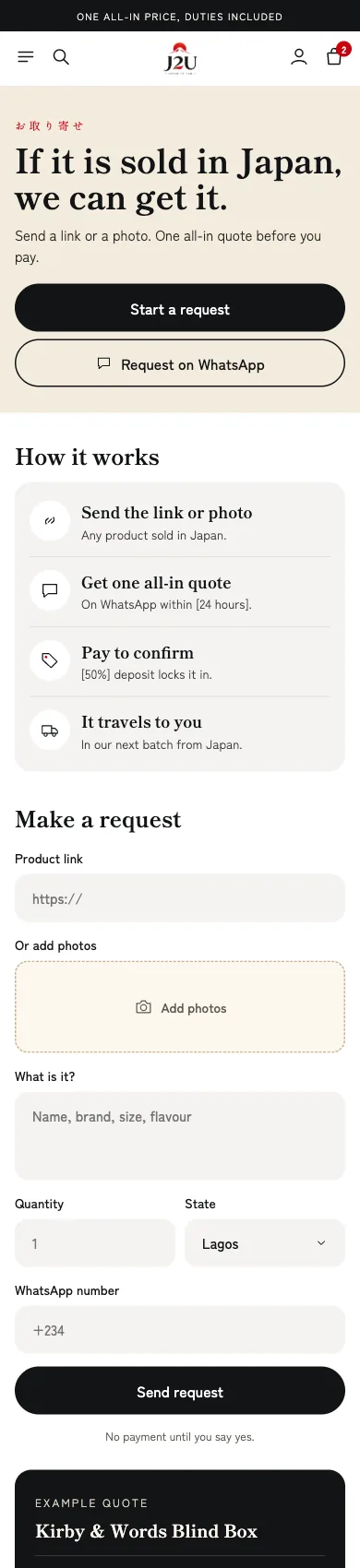
If a shopper cannot find an item, they send a link or a photo, get one all-in quote on WhatsApp, pay a deposit, and the item comes in the next batch. It has its own page, “If it is sold in Japan, we can get it”, a four-step explanation, and a form. Categories that are not ready open as “coming soon” pages with the same request form rather than empty shelves.Design-level
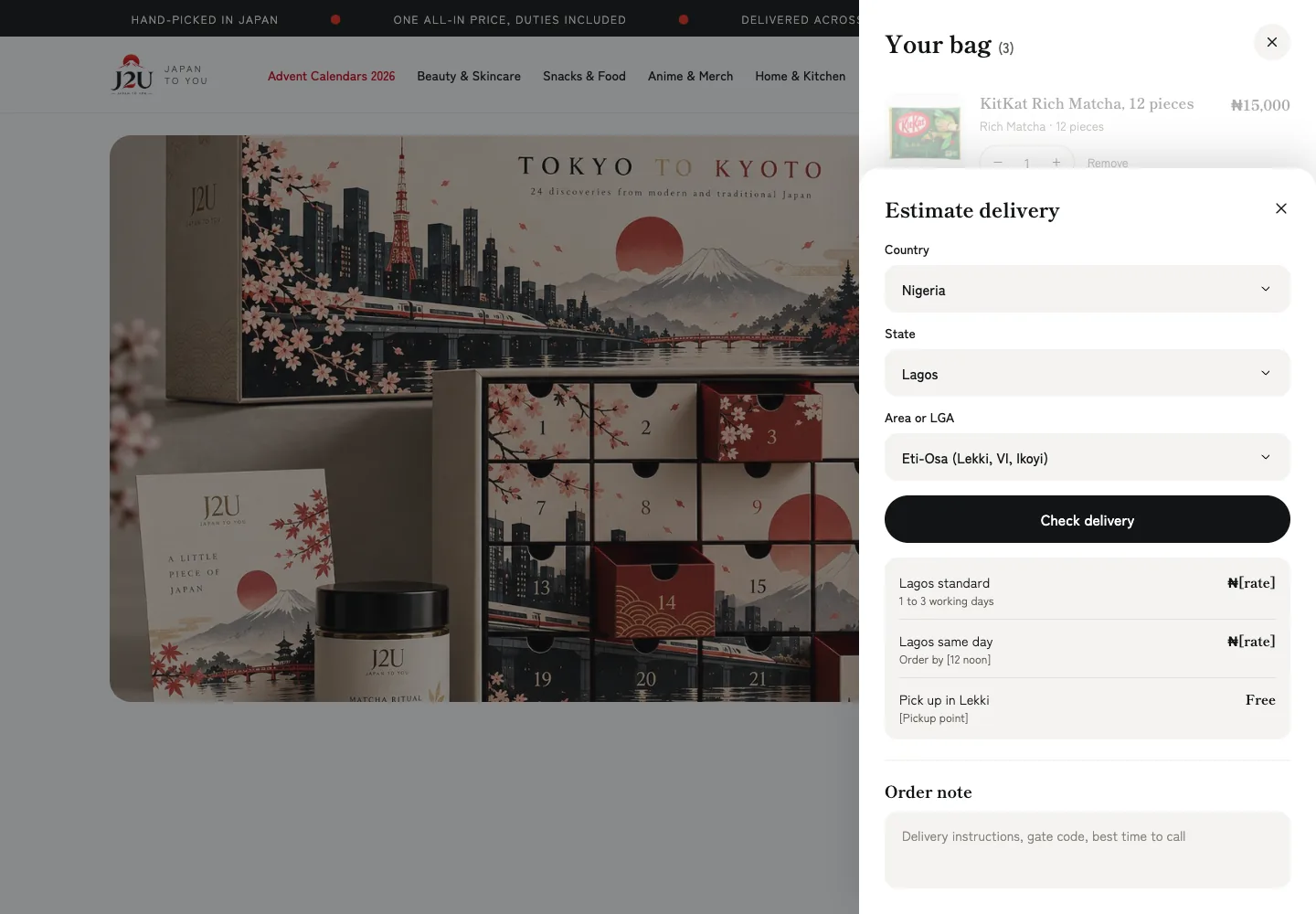
Estimate delivery inside the cart
The cart drawer has an “Estimate delivery” panel with country, state and area, three delivery options, and an order note for gate codes and call-me times. Japan Haul’s cart has none of this, and cart is where the doubt about cost and time bites.Judgement
04 — The brand system
Red, ink and cream. Real Japanese only.
The brand is led by red, ink and cream on white store pages, with a soft sand for sections. Headings, product names and prices use Shippori Mincho; body and interface text use Zen Kaku Gothic New. Buttons are pills, cards have a 16px radius. One colour from the first draft was removed. Two rules protect the tone: no decorative gradients, emoji or stock “lifestyle” filler, and every Japanese line on the site must be real and correct, never generated lookalike kana.Design-level
- Red #CA010FAccent, sale, buy now
- Ink #121416Text, buttons, dark bands
- Cream #FCF7EELight text on dark
- Kinu sand #F3EBDDSoft sections
- Matcha #2F6B3FIn Lagos, success
- Kohaku #8A5A00Ships from Japan, preorder
05 — The approved designs
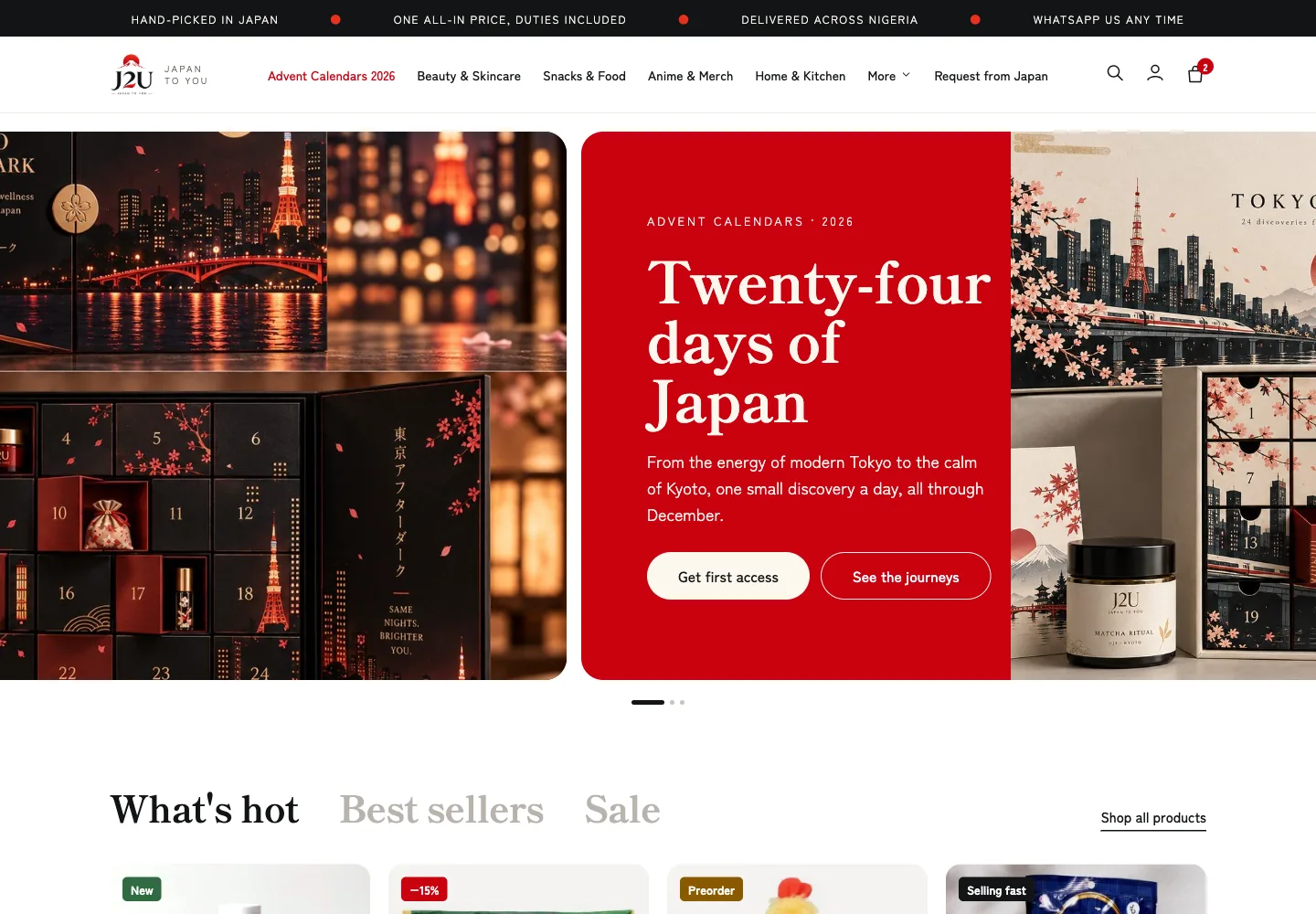
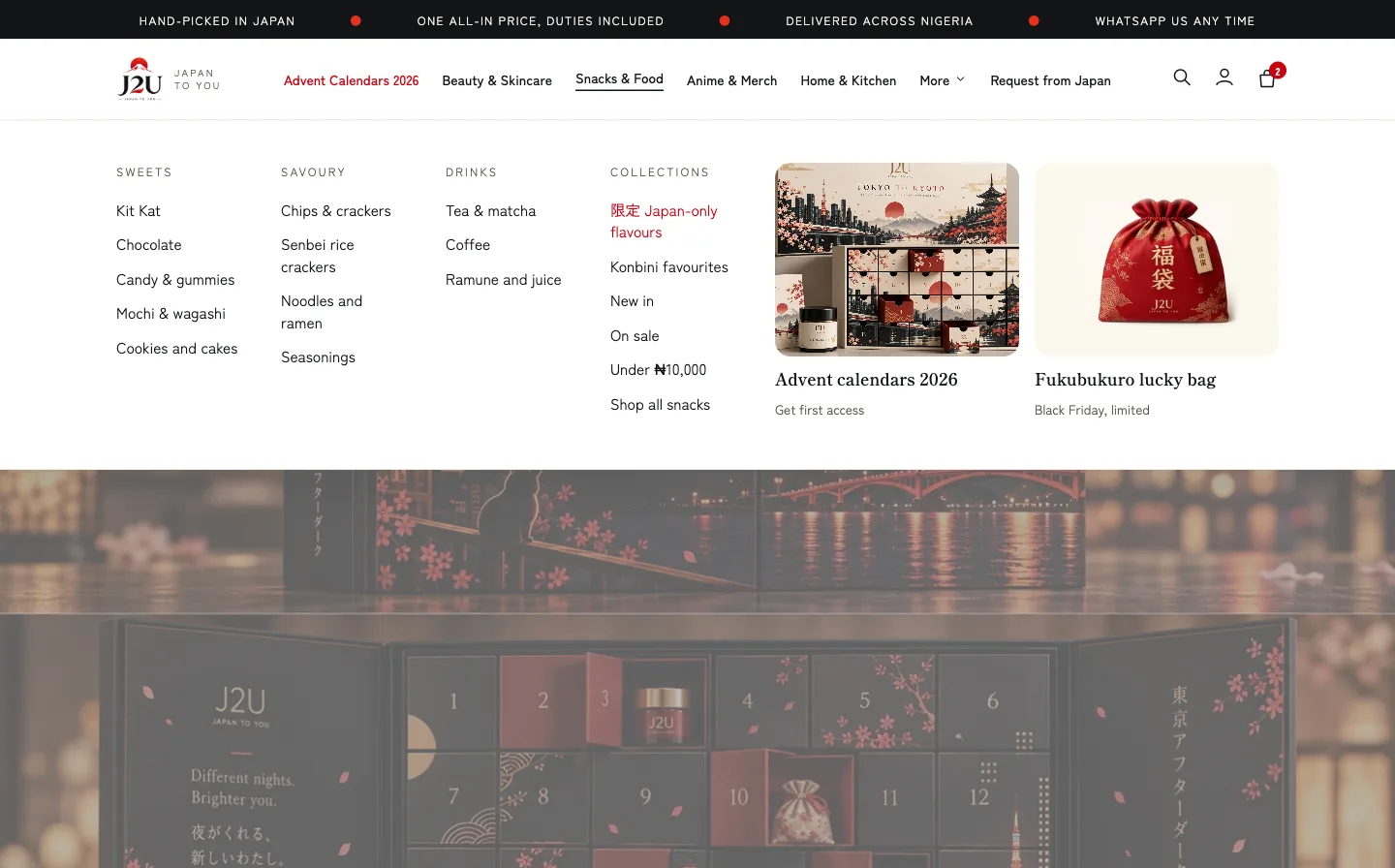
Twenty-seven boards, six of them here.
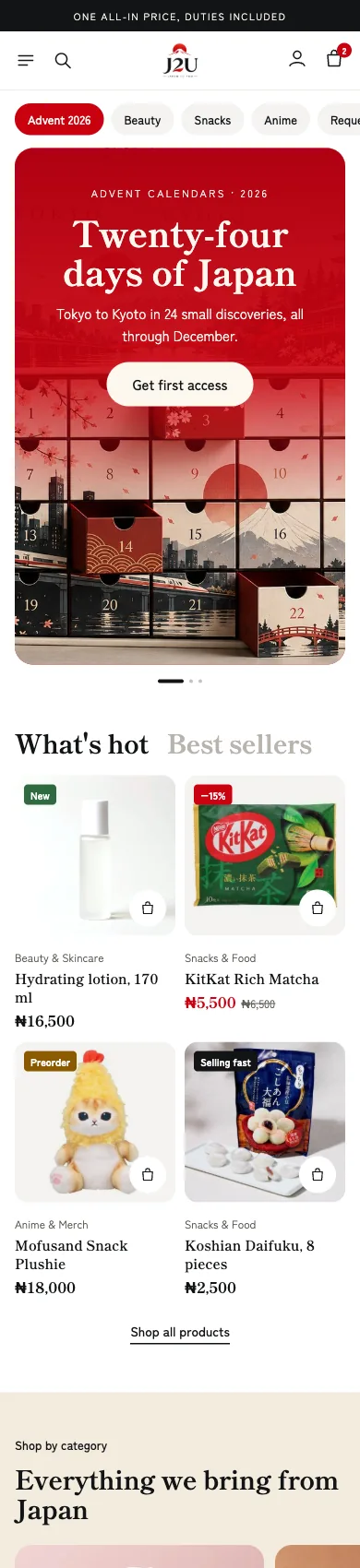
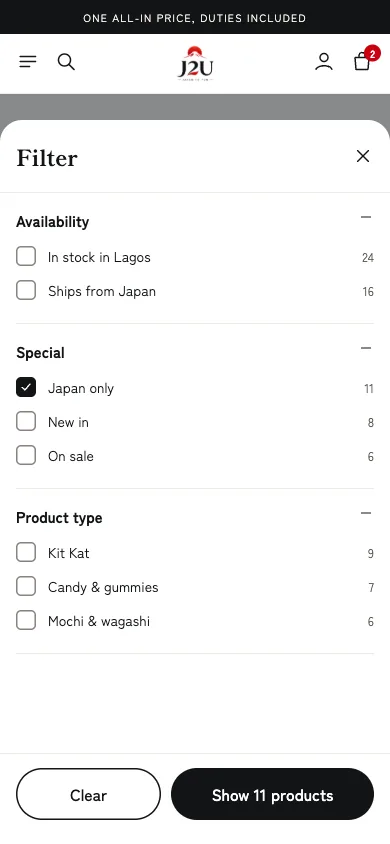
These are the approved page designs, not screenshots of the live store. Values that were still unconfirmed show as placeholders in square brackets, such as the delivery rates.
06 — Build and quality
Fixes found and made before launch.
A competitor audit on 14 October compared J2U’s build with Japan Haul and listed the gaps; a fix pass on 17 October closed the ones that mattered. Examples:
- The mega menu no longer repeats a parent link inside its own list; each sub-item opens the parent collection filtered by product type.
- Product types that are still awaiting regulatory approval are left out of the menu on purpose.
- The “Opening soon” waitlist page header no longer overlaps its heading on 320 and 360 px phones.
- Wording that said Nigeria only was loosened, because the founder plans to expand.
- Best sellers and What’s hot list only priced products with photos.
At the time of the 14 October audit, 43 of J2U’s 49 products had a single image, the biggest content gap. Photography, final delivery rates and the policy pages are the founder’s to confirm.
07 — What I’d measure
Judge it on what happens after opening.
The store opens on 31 October 2026, so there is no result to report. I would watch four things from day one: how many carts reach the delivery estimate, how many reach checkout, how many Request from Japan forms turn into a paid deposit, and how many questions arrive on WhatsApp about price or delivery. If that last number is high, the all-in price is not doing its job.Judgement